Call center AI software is redefining what customer service can be. Instead of long wait times, repetitive questions, and overwhelmed agents, modern contact centers are delivering fast, personalized, and efficient support across every channel. Solutions like call centre AI software leverage advanced technology to optimize interactions, while digital-era support strategies ensure omnichannel experiences meet evolving customer expectations. Meanwhile, virtual agent technology for modern call centers is empowering self-service, reducing agent workload, and speeding up resolutions.
Whether you run a small support team or a global contact center, AI can help you turn every interaction into a chance to impress customers, build loyalty, and drive revenue. This guide breaks down what call center AI software is, how it works, and how you can use it to create a high-performing, future-ready support operation.
Modern support centers rely on AI optimized cloud networks to handle large volumes of customer inquiries efficiently. By leveraging these systems, agents can focus on complex issues while AI speeds up repetitive tasks. To improve operational performance, businesses invest in high-speed supercomputer infrastructure, enabling faster data processing and predictive analytics.
Customer engagement is also enhanced using targeted marketing strategy solutions, which align outreach campaigns with AI-driven insights for better personalization. For multichannel campaigns, advanced marketing management tools help coordinate communication across email, chat, and social media platforms while AI handles routine questions.
Financial planning benefits from reliable financial investment guidance, helping companies allocate budgets effectively and maximize ROI from call center AI software initiatives. By combining these strategies, modern contact centers deliver efficient, scalable, and customer-centric experiences.
Top 10 Call Centre AI Software Solutions for Modern Contact Centers
In today’s digital era, businesses are increasingly adopting call centre AI software to enhance customer service, streamline operations, and deliver personalized experiences across multiple channels. Here’s a curated list of the top providers transforming the way contact centers operate.
1. Bright Pattern – AI Contact Center Excellence
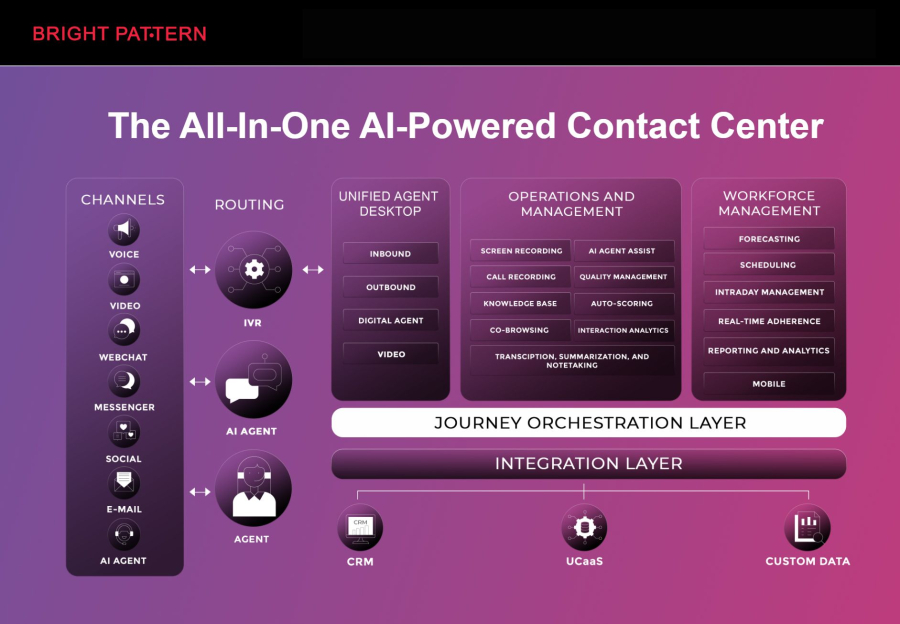
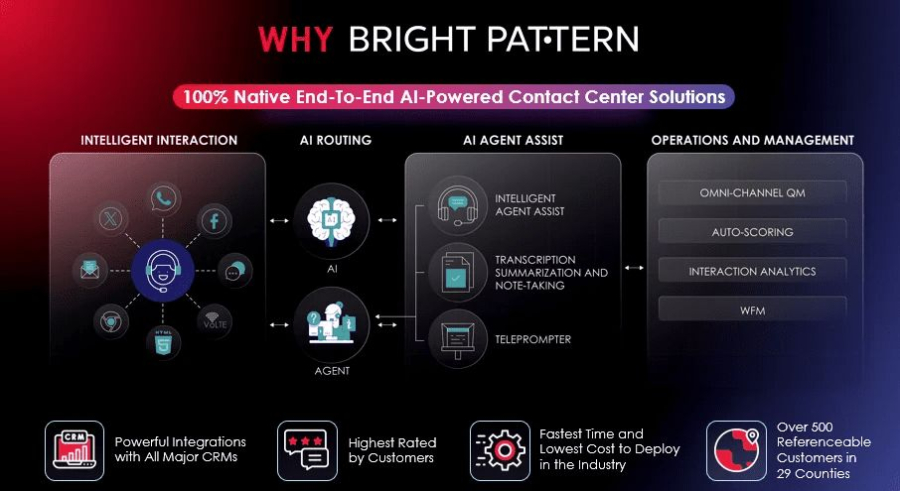
Bright Pattern stands out as a leading provider of AI-powered contact center solutions. Their software is designed to simplify complex customer interactions, improve agent efficiency, and deliver a seamless omnichannel experience.
Key features of Bright Pattern’s AI call centre software include:
- Intelligent routing to connect customers with the right agent every time
- Advanced virtual agents capable of handling routine inquiries and self-service tasks
- Real-time analytics to monitor agent performance and customer satisfaction
- Omnichannel support across voice, chat, email, SMS, and social media
- Easy integration with CRM systems for personalized customer interactions
Bright Pattern is ideal for businesses of all sizes, providing scalable solutions that help companies improve response times, reduce operational costs, and maintain high-quality customer experiences.
2. Genesys Cloud CX
Genesys Cloud CX offers AI-driven contact center solutions that focus on customer engagement and workforce optimization. It features predictive routing, AI chatbots, and advanced analytics to boost efficiency.
3. Five9 Intelligent Cloud Contact Center
Five9 provides a robust cloud-based platform with intelligent automation, AI-powered virtual agents, and real-time reporting. It helps businesses deliver proactive customer service and personalized support.
4. NICE inContact CXone
CXone combines AI and omnichannel routing to enhance contact center operations. It offers predictive analytics, workforce management, and conversational AI for better customer engagement.
5. Talkdesk CX Cloud
Talkdesk CX Cloud delivers scalable AI-powered solutions for modern contact centers. Key offerings include automated call handling, AI analytics, and virtual agents that improve efficiency and satisfaction.
6. Amazon Connect
Amazon Connect provides a flexible, cloud-based AI contact center solution. With natural language chatbots and machine learning integrations, it helps businesses deliver faster and smarter customer support.
7. RingCentral Contact Center
RingCentral’s AI-enhanced contact center software enables omnichannel communication, real-time insights, and intelligent routing to improve customer experiences and agent productivity.
8. 8x8 Contact Center
8x8 offers cloud contact center solutions with AI-powered tools for predictive engagement, automated workflows, and comprehensive analytics, ensuring smoother and faster customer interactions.
9. Cisco Contact Center AI
Cisco Contact Center AI leverages advanced AI for self-service automation, intelligent routing, and real-time insights, helping companies reduce wait times and improve customer satisfaction.
10. Avaya OneCloud CCaaS
Avaya OneCloud CCaaS combines AI-driven automation with omnichannel support to deliver consistent customer experiences while optimizing agent workflows and operational efficiency.
What Is Call Center AI Software?
Call center AI software refers to a set of tools and technologies that use artificial intelligence and machine learning to automate, assist, and optimize customer interactions. It works across phone, chat, email, and messaging channels to support both customers and human agents.
Core capabilities typically include:
- Intelligent virtual agents (IVAs)that handle routine customer requests via voice or chat.
- AI-powered routingthat matches customers to the best available agent or resource.
- Real-time agent assistancethat suggests answers, next steps, or upsell opportunities during live conversations.
- Speech analytics and transcriptionthat turn calls into searchable, analyzable data.
- Quality monitoring and coachingpowered by AI to evaluate interactions at scale.
- Predictive analyticsthat forecast demand, staffing needs, and customer behavior.
The result is a smarter call center that works faster, responds more accurately, and continuously learns from every interaction.
Why Call Center AI Software Is a Game-Changer
AI is not just another tool in the tech stack. For contact centers, it changes the entire operating model by blending automation with human expertise. Organizations see benefits across customers, agents, and operations.
Customer Benefits
- Faster response timesthanks to virtual agents, intelligent self-service, and smarter routing.
- 24 / 7 availabilityacross voice and digital channels, without needing round-the-clock staffing.
- More accurate answersbased on centralized knowledge and AI models trained on real interactions.
- Personalized experiencesthat adapt to a customer’s history, preferences, and intent in real time.
Agent and Team Benefits
- Reduced repetitive workas AI handles common questions, lookups, and simple workflows.
- Less pressure and burnoutbecause queues shrink and complex cases are easier to handle with AI guidance.
- Faster onboardingwith AI providing suggested responses, policies, and processes at agents’ fingertips.
- Continuous coachingfrom AI-driven feedback on tone, compliance, and best practices.
Business and Operational Benefits
- Lower operating coststhrough automation and improved agent productivity.
- Higher first contact resolution (FCR)as AI surfaces the right answers and routes correctly.
- Improved CSAT and NPSthanks to faster, more personalized issue resolution.
- Data-driven decisionsbased on detailed insights from every call and message, not just small samples.
- Scalabilityto handle seasonal spikes or rapid growth without a proportional increase in headcount.
Key Features of Modern Call Center AI Software
While every platform is different, most leading call center AI solutions share a core set of capabilities that work together to transform your operations.
1. Intelligent Virtual Agents and Chatbots
Intelligent virtual agents (IVAs) and AI chatbots handle routine interactions that used to require a human agent. They can greet customers, identify intent, authenticate identity, and complete simple tasks.
Common use cases include:
- Checking order status or delivery updates.
- Resetting passwords or unlocking accounts.
- Answering billing and payment questions.
- Collecting information before routing to a live agent.
Well-designed IVAs integrate with your CRM, billing systems, and knowledge base, so they deliver relevant, accurate responses instead of generic scripted answers.
2. Natural Language Understanding (NLU) and Intent Detection
Natural language understanding allows AI systems to interpret what customers say or type in everyday language. Rather than relying on strict menus or keywords, NLU models identify the customer’s intent and key details in the conversation.
This enables:
- Smoother voice and chat interactions without rigid prompts.
- Accurate routing to the right agent or department.
- Context-aware responses that feel more human and less robotic.
3. Real-Time Agent Assist
Real-time agent assist tools support live agents during calls and chats. As the conversation unfolds, AI analyzes it and surfaces helpful suggestions.
Typical agent assist capabilities include:
- Suggested repliesbased on similar successful interactions.
- Knowledge base recommendationsrelevant articles or procedures.
- Next best actiontips for resolving issues or positioning additional services.
- Compliance promptsreminding agents of required disclosures or scripts.
This not only boosts performance for experienced agents but also helps new hires ramp up quickly and confidently.
4. Speech Analytics and Transcription
Speech analytics tools convert voice calls into text in real time or after the interaction, making it possible to analyze 100 percent of your calls instead of a tiny sample.
With speech analytics, you can:
- Identify common customer issues and trending topics.
- Monitor sentiment and emotional tone across conversations.
- Flag potential churn signals or escalation risks.
- Detect compliance issues or script deviations.
These insights feed directly into training, process improvements, and product decisions.
5. Automated Quality Management and Coaching
Traditional quality assurance teams often review only a small percentage of interactions. AI-driven quality management automatically scores a far larger volume of calls and messages using predefined criteria.
This enables:
- Fair, consistent evaluation across the entire agent workforce.
- Faster identification of coaching opportunities.
- Objective metrics to track improvements over time.
Supervisors can spend less time manually reviewing calls and more time delivering targeted coaching that drives performance.
6. Predictive Analytics and Workforce Optimization
Predictive models help you anticipate future demand and optimize workforce planning. By analyzing historical patterns, seasonality, marketing campaigns, and product changes, AI forecasts call and message volumes more accurately.
With those forecasts, you can:
- Staff the right number of agents for peak and off-peak periods.
- Reduce overtime and unnecessary labor costs.
- Maintain service levels even during unexpected spikes.
Before and After: The Impact of AI on Call Centers
The move from a traditional call center to an AI-augmented operation can feel dramatic. The table below highlights typical changes organizations experience once AI is in place and properly adopted.
|
Area |
Before AI |
With Call Center AI Software |
|
Customer Wait Times |
Long queues during peak hours, limited coverage after hours. |
Virtual agents and smart routing reduce queues, with 24 / 7 self-service. |
|
First Contact Resolution |
Inconsistent, heavily dependent on individual agent knowledge. |
AI surfaces answers and context, improving consistency and FCR. |
|
Quality Assurance |
Small sample of interactions manually reviewed each month. |
Automated scoring of most or all interactions with clear coaching signals. |
|
Agent Experience |
High cognitive load, repetitive questions, and information hunting. |
AI handles routine tasks and provides in-the-moment guidance. |
|
Operational Visibility |
Limited reporting, delayed insights, and guesswork on trends. |
Real-time dashboards and deep analytics from every interaction. |
|
Scalability |
Growth requires hiring and training more agents linearly. |
Automation absorbs volume increases, with focused hiring for high-value work. |
High-Impact Use Cases for Call Center AI
AI can touch nearly every part of your customer support operation. Focusing on a few high-impact use cases at the start makes adoption smoother and ROI clearer.
1. Automating High-Volume, Low-Complexity Requests
Look for frequent, predictable inquiries that follow a clear process. These requests are ideal candidates for virtual agents.
- Order tracking and shipping updates.
- Account balance inquiries.
- Appointment confirmations and rescheduling.
- Basic troubleshooting steps or FAQs.
By diverting these routine tasks to AI, your human agents can focus on complex, high-value interactions.
2. Boosting Sales and Retention Through Service Interactions
Every support call is an opportunity to deepen the customer relationship. AI can detect potential cross-sell, upsell, or retention moments by analyzing customer behavior and conversation cues.
- Suggest relevant add-ons or upgrades when a customer expresses interest.
- Trigger retention offers when sentiment or language suggests frustration.
- Highlight high-lifetime-value customers for priority handling.
This turns your contact center from a cost center into a powerful revenue and loyalty driver.
3. Intelligent Triage and Routing
Instead of routing calls and chats purely by skill group or menu selection, AI-based routing evaluates the context, history, and intent of the customer.
- Direct VIP or high-risk customers to specialized teams.
- Route technical issues to agents with the right expertise automatically.
- Balance workloads by considering current queues and handle times.
Better routing leads to shorter resolution times and higher customer satisfaction.
4. Proactive Support and Outreach
Predictive analytics can help you act before issues escalate. Instead of waiting for customers to contact you, AI alerts your team to patterns that might indicate a looming problem.
- Detect increased contacts about a new feature or product bug.
- Identify customers whose behavior signals potential churn.
- Trigger proactive check-ins or notifications to reduce inbound volume.
How to Successfully Implement Call Center AI Software
Successful AI adoption is not just about technology; it is about strategy, process, and people. A thoughtful rollout helps you unlock value quickly while building trust across your organization.
1. Clarify Your Business Objectives
Start by defining what success looks like for your organization.
- Are you aiming to reduce average handle time or overall contact volume?
- Is improving customer satisfaction your top priority?
- Do you want to boost agent productivity or lower turnover?
Clear goals will guide your choice of use cases, metrics, and technology partners.
2. Start Small, Then Scale
Begin with a focused pilot targeting a specific process or interaction type, such as password resets or order tracking. Measure impact, gather feedback, and iterate before expanding.
This approach lets you:
- Demonstrate quick wins to stakeholders.
- Refine conversation flows and AI models with real-world data.
- Build internal champions among agents and supervisors.
3. Integrate with Your Existing Systems
The power of call center AI software multiplies when it connects deeply with your existing tools.
- Customer relationship management and ticketing systems.
- Knowledge bases and internal documentation.
- Telephony and contact center platforms.
- Workforce management and analytics tools.
Integrated data ensures that AI has the context it needs to provide accurate, personalized support.
4. Engage and Empower Your Agents
When agents view AI as a partner rather than a threat, adoption accelerates. Involve them early in the process.
- Explain how AI will reduce repetitive tasks and help them succeed.
- Invite feedback on conversation flows and suggested responses.
- Provide training on using new tools and interpreting AI insights.
Agents who feel supported and heard are more likely to embrace new technology and deliver standout service.
5. Design for the Customer Experience
AI should make things easier and more pleasant for customers. When designing your virtual agent flows and AI interactions, focus on clarity and empathy.
- Use natural, concise language that mirrors how customers speak.
- Offer clear options to reach a human when needed.
- Test experiences with real customers and refine based on feedback.
6. Measure, Learn, and Improve
AI thrives on data. Track both operational and experience-based metrics to understand performance and opportunities.
Key metrics to monitor include:
- Containment rate for virtual agents (issues resolved without a human).
- Average handle time and first contact resolution.
- Customer satisfaction scores and sentiment trends.
- Agent productivity, adherence, and coaching outcomes.
Use these insights to fine-tune models, update knowledge bases, and continuously optimize workflows.
Choosing the Right Call Center AI Software
The right AI platform should align with your goals, technology stack, and team capabilities. While specific vendors differ, you can use the following criteria to guide your evaluation.
1. Capabilities and Roadmap
Consider the features you need today and where you want to be in the next few years.
- Does the platform cover your priority use cases, such as virtual agents, real-time assist, and analytics?
- Can it support additional channels or use cases as your strategy evolves?
- Is there a clear roadmap for ongoing innovation and improvements?
2. Ease of Integration
Successful AI is tightly integrated with your contact center and business systems.
- Check compatibility with your telephony, CRM, ticketing, and workforce management tools.
- Look for flexible APIs and prebuilt connectors that shorten implementation time.
- Ensure data flows securely and reliably between systems.
3. User Experience for Agents and Admins
Agent and supervisor interfaces should be intuitive and designed for daily use.
- Agents should see clear, actionable suggestions without clutter.
- Supervisors should be able to set up rules, scorecards, and workflows without heavy coding.
- Analytics dashboards should be easy to interpret and share.
4. Accuracy, Reliability, and Control
AI quality directly impacts customer and agent trust.
- Assess how the system is trained and how it continues to learn from new data.
- Verify accuracy rates for speech recognition and intent detection.
- Ensure you can review, override, and refine AI suggestions and automations.
5. Security, Compliance, and Governance
Customer interactions often involve sensitive information. Your AI tools must be designed with security and compliance in mind.
- Confirm adherence to relevant industry and regional regulations.
- Understand how data is stored, encrypted, and anonymized where needed.
- Establish clear governance over who can configure AI and access insights.
The Future of Call Centers With AI
As AI models grow more capable, call centers are steadily evolving into intelligent customer engagement hubs. The trend is not about replacing humans; it is about enabling smaller teams to deliver exceptional experiences at scale.
Expect to see:
- Even more natural conversations with virtual agents, blending voice, text, and visual elements.
- Deeper personalization driven by unified profiles and predictive models.
- Closer alignment between service, sales, and marketing using shared interaction insights.
- Expanded roles for agents as trusted advisors, supported by powerful AI copilots.
Organizations that adopt call center AI software thoughtfully today will be well-positioned to lead on customer experience tomorrow.
Conclusion: Turning Your Call Center Into a Strategic Asset
Call center AI software gives you the tools to move beyond reactive, volume-driven support and toward proactive, personalized customer engagement. By combining intelligent automation with empowered human agents, you can deliver faster resolutions, higher satisfaction, and more meaningful relationships at every touchpoint.
With the right strategy and implementation, your call center can become a powerful growth engine and a key differentiator in how customers experience your brand.
